 |
| The view from my window & terrace - perhaps the best in Copacabana! |
Monday, March 26, 2012
Copacabana and Isla del Sol – the marvels of Lake Titicaca
Titicaca Lake ended up on my travel list basically because it was conveniently
located between Bolivia and Peru and it sounded interesting as it’s the highest commercially
navigable lake in the world, at 3800m in altitude. And because it sounded funny! I was a bit weak
after being one day sick in La Paz so when I arrived to Copacabana that
afternoon I just checked into my luxury hostel (Hostal las Olas – highly recommended!)
and made a camp in my bed. And it was a superb hostel indeed, with a view of
the lake even from the bed :) I had a big room (for five people actually) just for
myself, a stylish kitchen with tabletops made of huge slabs of rock and two wooden
sinks in the kitchenette, a stone lined shower in the bathroom, a fireplace in
the room…. In the terrace I had a stone table and hammocks where you could
chill and look at the Titicaca lake. Nice place just to hang out.


Monday, March 19, 2012
Sick and tired in La Paz
It was quite the shock to arrive in the cold, dark and rainy Bolivia after three hot weeks in Brazil. Yes, I knew it would be cold but it always amazes me
how in these cold Latin American places it’s also cold inside the houses (coming from a cold country where it’s warm
inside the houses, not cold). And in La Paz – at the altitude of around 3600m
above sea level – it was cold inside, outside… Only during the days when there
were those nice moments that the sun came out it was actually enjoyable to be
outside (and it was still cold inside). Luckily there were those moments
too.

The first morning when I woke up it was raining in La Paz so I just went
to have breakfast and climbed back to bed. At around lunchtime I finally
stepped out of my hostel to see this high altitude city. I wondered up and down the
small streets in the center of La Paz… There were lots of streets that were so steep that there were actual steps, not a flat pavement. The center is full of shops, cafes
and restaurants, tour agencies and exchange offices. Mostly you’ll see small
arts & crafts stalls selling alpaca sweaters, scarfs, hats, mittens,
shawls, socks and legwarmers; leather and canvas bags; jewelry of all sorts; all
kinds of textiles and paintings. Everything looks cute, warm, soft and most of
all colorful. And best of all: cheap. Like for everything there (food, accommodation,
transport…), you’re paying just a fraction of the prices in Argentina, Brazil
and Chile. So if you want to (or can – I can’t fit anything more in my bags)
buy some souvenirs, this is the country to do it! Mexico was the same. It kills
the shopaholic-me to pass by all those shops and not to buy a ton of things. If I could only buy a containerful of stuff and ship it home...

 |
| The steep hills of La Paz, rising up to around 4km in altitude |

Saturday, March 17, 2012
Week in the life of a zouk dancer in São Paulo (- and it isn’t a bad life!)
After the Floripa carnival and a couple days relaxing on the beach at
Ilha do Mel I was ready to enter one of the biggest cities in South America,
São Paulo. A massive city - by population (about 19 million) and by physical
size, the metropolis spreads out tens of kilometers in each direction, melting
into smaller cities of southern Brazil. It is actually the largest city in the southern hemisphere! I was already a bit hesitant just
thinking about the place due to the sheer size of São Paulo and all the dangers
& annoyances that come along with it but knew I had so much to look forward
to: meeting some friends I met earlier in Rio and especially getting back to my
normal (dream) life – dancing zouk!
 |
| São Paulo from air (pic I took leaving the city) |
My trip from Ilha do Mel to Sampa (as some affectionately call the city) didn’t go as smoothly as I had hoped. Apparently it was the end of summer time that late February Sunday morning and I had woken up one hour too early – very confused at first about this but just happy I didn’t get up one hour too late… I had a big breakfast and got on a boat to Pontal do Sul. There I was hoping to catch one of the surely full buses to Curitiba where I could catch another bus to São Paulo. But indeed the buses were full so a Spanish lady and I shared a taxi from the port to the bus terminal where we first took a local bus to Paranaguá, from there a bus to Curitiba and from there a bus to São Paulo. I didn’t have to wait for too long in any of the points but it all accumulated (plus the last bus being stuck in traffic) so, having left the island before 9am in the morning, at 10.30pm I arrived to (500 km away) São Paulo. From there it was only a 20 min cab ride though the stormy city to my friend’s place where I was warmly welcomed by three guys – this would be my home for the next week!
Thursday, March 15, 2012
Ilha do Mel – sweet beaches in Southern Brazil

There’s two main villages where you can stay on Ilha do Mel: Encantadas and Brasilia. I chose the Encantadas and it turned out to be a safe bet: about a 100-200m stretch of sand, lined with restaurants, hostels, pousadas and camping sites – and even one mercado. Our hostel – like all of them – had a lovely porch straight on the beach and a huge breakfast. On the Brasilia village the hostels were in the woods, off from the beaches. You quickly notice why there are no cars on the island: there are no roads, just some trails that connect the different villages and beaches.
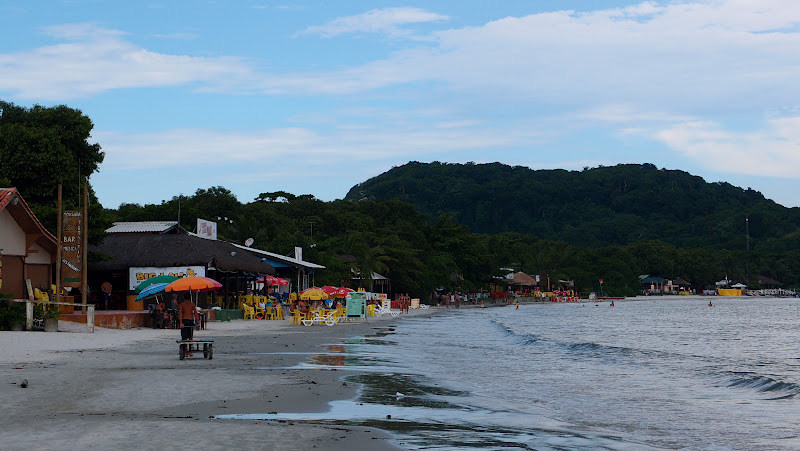 |
| Encantadas |

Tuesday, March 6, 2012
My Brazilian samba parade!
Brazil... Carnaval... I certainly wasn't going to miss a samba parade at the local Florianópolis sambódromo! The main parade on Saturday was sold out by the time I got there on Friday so I got a ticket to the next best thing, the final parade - the
champions’ parade held the following Tueday.
And I made sure I was there early. The parades are at the
Floripa samba street, sambódromo (yes, they have one too, like in Rio). It’s like
a sports stadium but with one straight white concrete
alley going through it. It's a funny concept to have a stadium for basically a couple events per year (or do they actually use it for something else too?) but in the Brazilian mindset it might be just the thing.
When I came there at around 7 pm there was just a handful of people in
the audience and even when the first parade groups started at around 8pm it was mostly empty.
But I was having too much fun cheering to the dancers and taking pictures of
all the fabulous costumes and floats! I didn’t even notice that the whole area
filled up to the brim by midnight! And I didn’t have to be there for long until
I attracted new friends, a huge group of Israelis adopted me. I really didn’t follow what the program was since all
the announcements were in Portuguese – but who cares as long as the cheering
dancers kept rolling pass me.
The most impressive things in the parade? There
were lots of them: the young dancers really knew the samba moves,
even the kids. The passistas (solo dancers) obviously had worked on their samba
no pé since they were kids and it was fun to watch them when they really kicked
in the high gear. The mestre salas (the male dancer in the flag duo) were spinning
like crazy! And I loved how smoothly the male solo dancers do the samba no pé. There
were lots of groups with precise choreographies, really long ones… I paid
attention to a couple of the groups and felt that I didn’t even see them repeat
the sequence in the entire time they passed me (which usually would take longer
than one run of their enredo). The baterias (the bands) were massive and I
think they were the groups that really got the crowd going.


Wednesday, February 29, 2012
Carnaval in Floripa! Drag queens, caipirinhas, samba and white beaches…
Three flights. Three effing flights. Never again will I book a trip to
somewhere with two stopovers. This time even the second flight left an hour
late so made second change was a bit more “exciting”. But these are the things
a girl needs to do to get to a nice carnival! So I flew from Argentina to
Brazil, from Salta to Florianópolis (=Floripa), on the Thursday before the Carnaval. The
Carnaval - a Catholic holiday - is a major event all over Brazil, in most places in South America
as well as many places in the rest of the world as well. The Brazilian Carnaval though seems to have nothing to do with anything that resembles a religious holiday ;)


I had heard that Floripa is one of the nicest places to see the carnival
in the southern Brazil. I manage to get the (idiotic) flight and a hostel there
so I was all set! I was staying in the island in front of the city of
Florianópolis, Ilha Santa Catarina, as most tourists do. The island is full of
beaches and funky “towns” or neighbourhoods and there’s a lake as well. My spot
was at the lake, Lagoa de Conceição. Lagoa is pretty much in the center of the island and there's plenty of shopping, restaurants, bars and hostels. Also kite surfing spots!


Saturday, February 25, 2012
Salta - and final words on Argentina
I guess I needed some rest after all the touring during my Argentina leg of
the trip so I decided I wouldn’t do anything in Salta. And it worked out pretty
well. I was responding to emails, making updates on my blog, arranging photos,
booking a flight… ok so not totally relaxing. But it was nice to not have a set
“day plan”, I just walked around in the city – and somehow always managed to do
that during siesta. Salta really closes down
for siesta, unlike some of the more “touristy” towns along my road.

 |
| One of the prettiest parks I've seen, in the center of Salta |

Friday, February 24, 2012
The many colors of Northern Argentina - Jujuy
One of the most interesting places on my trip was the Jujuy region in
the Northern Argentina. I was recommended to go there by a Porteño friend of
mine Maria so I had put it on my long list. Jujuy or more specifically San
Salvador de Jujuy is 90km north of “the capital of the Northern Argentina”
Salta and wanted to make a visit there before Salta. I left Mendoza Saturday at
noon and arrived to Jujuy at 8 am the next morning. I woke up a bit before we
arrived so I got to “enjoy” the breakfast they served in the bus (tea or
coffee, alfajor-cookie, bisquits and jam) and enjoy the views as we passed
between green fields, forest covered hills and mountains.

I was fairly tired and moreover tired of travelling, packing, unpacking,
walking, carrying my backpack… So doing nothing special for one day sounded
like a good idea. I was relaxing in the hostel, playing with the kittens that
lived in hostel roof, walked a bit around the town. I had a super heavy steak
dinner in a nice restaurant (and it was cheap there!) and was ready sleep quite
soon after that.
 |
| Lots of beautiful churches... |
 |
| The empty streets of Jujuy on Sunday |

Vines and wines – Say Malbec, you’re in Mendoza!
Thanks for the beautiful Northern Argentina, the amazing Brazilian Carnaval and all the great people I've met I'm again behind on my blog. But no worries, I've used all (well some parts) of the long bus rides to write stuff and organise pictures so I can start making blog posts during all the quiet moments I have - so many fun stories & gorgeous pictures to share!


So --- I’m becoming an expert in long bus rides. Another 19 hours of sitting
(with over two hours circling the different terminals in Neuquén) I got
myself from Bariloche to Mendoza. Thankfully the bus seats are comfy, there are TVs
with crappy movies and if you bring your own snacks, warm clothes (OMG tone
down on the air con!) and some light entertainment – like your laptop – you’ll
have a somewhat relaxing day ahead.
It was morning when I arrived in Mendoza. I had managed to pick a nice
hostel again, this happened to have been voted the best hostel in South America
(by hostelworld users, one myself). My bed wasn’t free that early but I got
myself all cozied by in a hammock in the garden, frankly I was a bit tired. So
after noon I was ready to venture out to the city.
My bible (Lonelyplanet) told me that Mendoza was once been eradicated by
an earthquake and after that was built with wider avenues and larger plazas to
help clearing out the next disaster – very nice for walking around and people
watch. I walked through most of the leafy downtown which I admit was nice but
it missed some of the wibe of Buenos Aires. Couldn’t put my finger on it but it
wasn’t as interesting.
I headed towards the San Martin park and the sheer size
of it just hit me when I arrived. It was something in the scale of Central
Park, maybe even bigger, I think the full length was around 5km? So forget
about walking through all the park, actually you can drive through the various
tree lined streets. Unfortunately the park also lacked all the charm. Just a trees here and
there and worn down grass, t didn’t invite you to walk around the green areas,
you’d basically just stroll around the streets. The lake was quite pretty and
there I found some flowers as well. There was a big tennis club where there was
also a pool – that looks like a nice way to spend a hot day and I’m sure that’s
where the city people flock during the weekends.


Tuesday, February 14, 2012
Lakes lakes lakes – Bariloche
After the icy adventures in El Calafate I got on yet another bus,
this time it would be the longest bus ride of my life (so far): 28 hours. We’d
leave at 4pm from El Calafate and arrive 8pm the following day to Bariloche. I
met some people at my hostel who were taking the same bus so I didn’t feel too
lonely on this ride. The bus was a nice “cama” class bus with only three seats
in one row, a footrest and plenty of space for a tiny person like myself. This
ride also came with some meals.

So what to do in a bus for 28 hours? Eat. Listen to your mp3-player til
your ears start to hurt. Watch movies on the bus TV screens (we had some
English speaking movies on this one, yay!). Arrange your pictures and write
stuff your blog on your laptop. Organise your mp3-player because you get bored
of your playlists. Read a guidebook and plan the next couple weeks of your
trip. Sleep. And sleep some more. Luckily I have no problems sleeping in moving
vehicles at the moment so I think I slept at least 10 hours. The rest of the
time went very fast too. We stopped maybe three times on the way to stretch our
legs and once to change a bus.


After what felt like 10 hours we arrived to Bariloche, the Argentinian
lake district. This was another “ski resort look-alike” kind of town but bigger
than El Calafate. And it was next to one the most beautiful blue lake, Lago
Nahuel Huapi. The winds tended to be quite strong here but when they calmed
down it was rather warm. I was surprised to see 22C in the weather forecast but
I admit that’s what it felt like! Locally Bariloche is known for “artesan”
chocolate shops (on in every corner), the hills that surround it that offer
magnificent hiking, cycling, kayaking.. you name it.. and the ash. There was a
volcano eruption close to the city and the ash clouds closed the city airport
for quite a while and slowed down the tourism there for this season. The best
hostels still tend to get booked up in Jan-Feb so book yours as early as you
can. There’s also gorgeous cabanas, house and hotels on the shore of the lake,
a bit out of the city, that I would have loved to stay in if I were in town
longer!
You can take the local busses to the foots of the hills by the lake. I
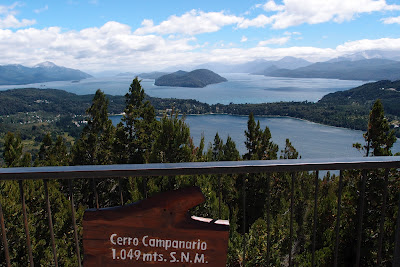
climbed two peaks – Cerro Campanario (1049m) and Cerro Llao LLao (about 1km). On the first
day I had actually thought about doing nothing to recover from the bus ride and
an enormous steak I had in the locally famous Parilla Alberto after we arrived.
But with a small European team (two Germans, one Dane and one Italian) I left
to 17 km west from Bariloche to “take a nice walk” art Cerro Campanario. It
turned out to be this 1km hill we would ascend. Ok, I’m game for anything! The
hill was pretty steep though, and the ground was covered by sand (or was that
ash?) so it was a challenge for sure. So decided I’ll just climb as fast I can
so that it’s over and done with. It took about a half an hour to reach the top. And yes, the views were
great.


Sunday, February 12, 2012
I’d like my whiskey with ice, please!
Not tired of hiking in the mountains, valleys and around lakes in the
beautiful Patagonia yet? Well welcome back to Argentina! About 4-5 hours
(depending on how fast the border crossing is) north of Chile’s Puerto Natales
& Torres del Paine is Argentina’s El Calafate. Yes yes, it's another pretty
village with nice shops and restaurants, looks actually more like a ski
resort than a South American small town. The night life is pretty busy and
there’s big casino in town as well but most people come here to see one more
Patagonian natural wonder: the Perito Moreno glacier.
I had a lovely bus ride from Puerto Natales to El Calafate, sitting on
the first row to see the beautifully boring Patagonian landscape all the way.
At last when the sun set behind the flat Patagonian wilderness I could fall
asleep. It was a late at night when I arrived to El Calafate but with the help
of my hostel there I had manage to book a tour to the glacier early next
morning.
 |
| Nothing - as far as the eye can see |

Saturday, February 11, 2012
Torres del Paine - the towers of ..pain?
As long I was in Southern Chile, there was another must-see destination: Torres del
Paine. One of the trekking capitals of the south, Puerto Natales, is the
closest town (or a village really) to the mountain and the national park. It’s
a windy little place with some quaint cafes and restaurants and tons of tour
agencies and trekking outfitters. At the local hostel Erratic Rock they hold an
information briefing for trekkers every day. I went in to have a peak of what
they tell there and the place was full of gore text clad 20 and 30 something
trekking enthusiast. This is really the area where you should head if you like
to hike and camp in the mountains. If you hope it’ll be cheap – it won’t be. Just to get in to the park
grounds you have to pay 15000 Chilean pesos (23€). You can either stay at the refugios
along the trails or camp - not cheap either. But I’m sure the experience and the sceneries will be worth it.
But I wasn’t going to sign up for the 3, 4 or even 9 day hikes you can
do around the mountains. No, I didn’t have the equipment for it or the time or
the money – or the trekking enthusiasm. The next morning after I arrived there
I went on a tour to the National Park around the mountains and I was happy I
wasn’t going to camp or hike on the mountains. The weather was very
unpredictable, one minute rain and sunshine the other, the winds were “knock
you off your feet” –strong and the views sometime obscured by the clouds. I was
quite happy with my cheap & easy option, the full day tour, safe &
sound close to a shelter (a minivan) all the time.
First on the tour was a visit to the Milodon cave, a huge cave which was
thousands of years ago the home to these huge mammals. It’s not a very
interesting site but I was surprised to hear later they use the cave also to
host some cultural events of the village – that sounds fun! After that we entered the park and headed to the lakes, first Lago Toro
and then Lago Grey, where the Glaciar Grey icebergs float to shore.
 |
| Lago Toro - yes, the colours are crazy! |
 |
| Entering the park |

Subscribe to:
Posts (Atom)